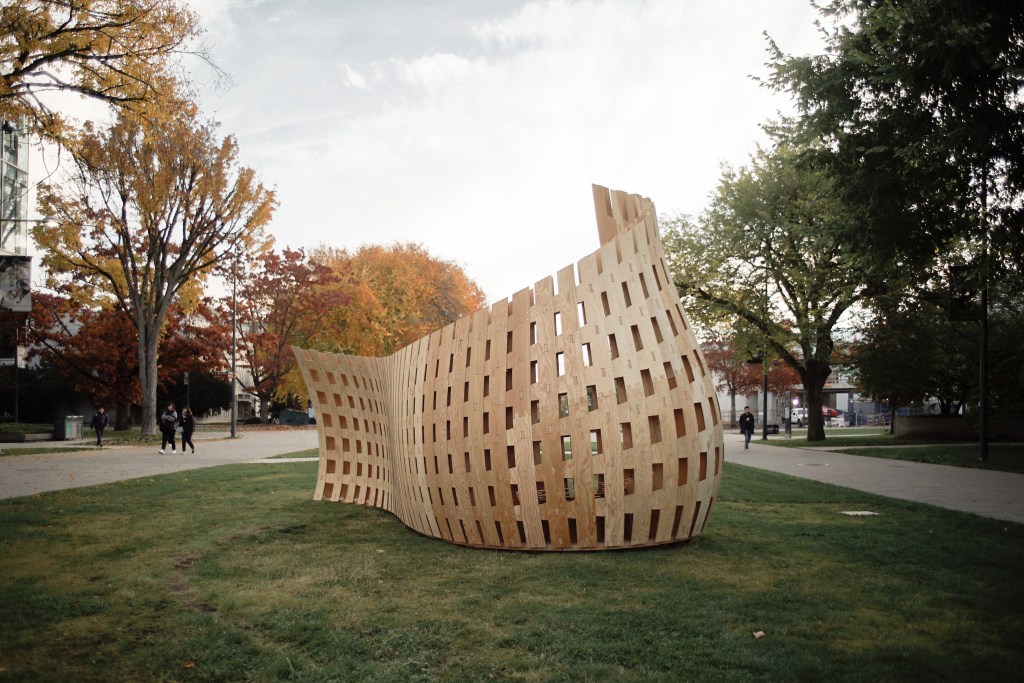
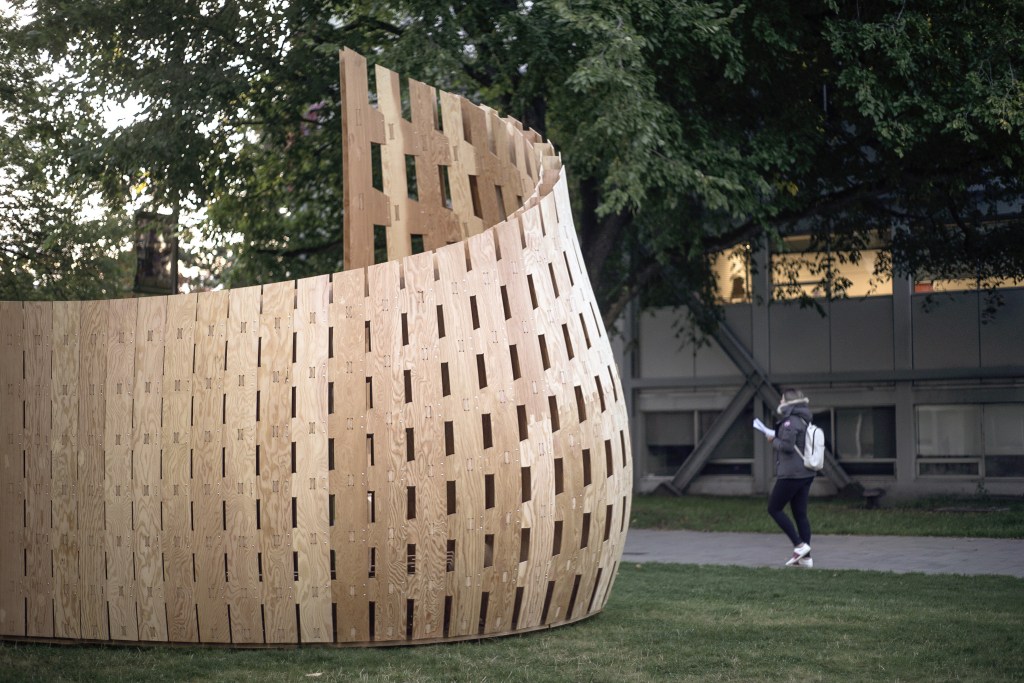
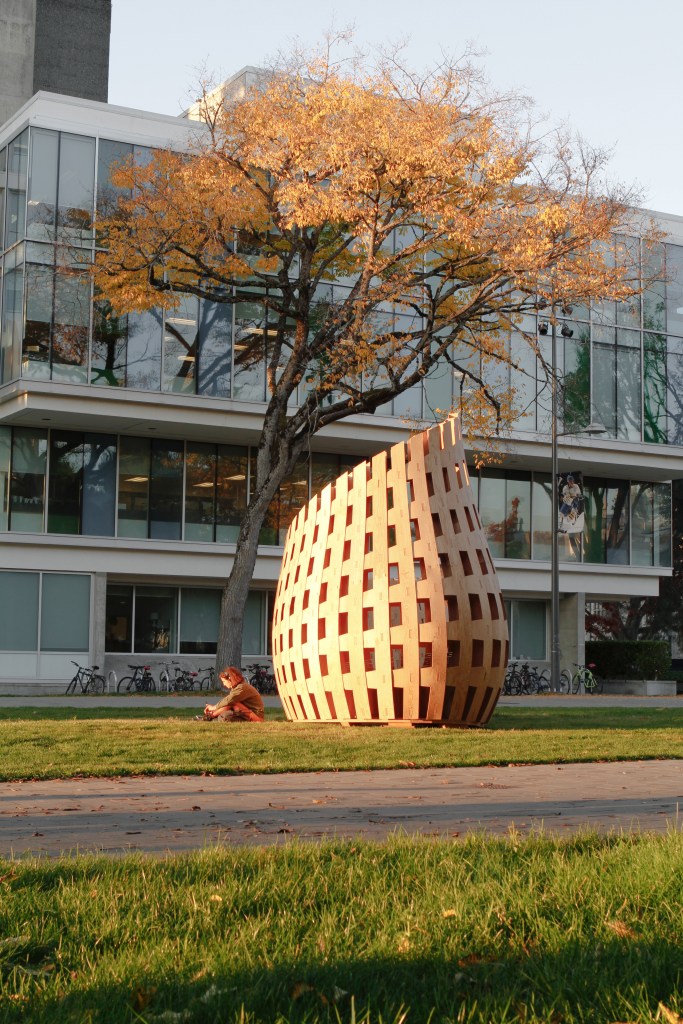
The Wander Wood Pavilion is a robotically fabricated temporary installation at the University of British Columbia Campus. The pavilion is the result of the Robot Made: Large-Scale Robotic Timber Fabrication in Architecture workshop, hosted by SALA and the UBC Centre for Advanced Wood Processing from October 13–17. The workshop was led by David Correa of the University of Waterloo, Oliver David Krieg of LWPAC, and SALA professor AnnaLisa Meyboom.
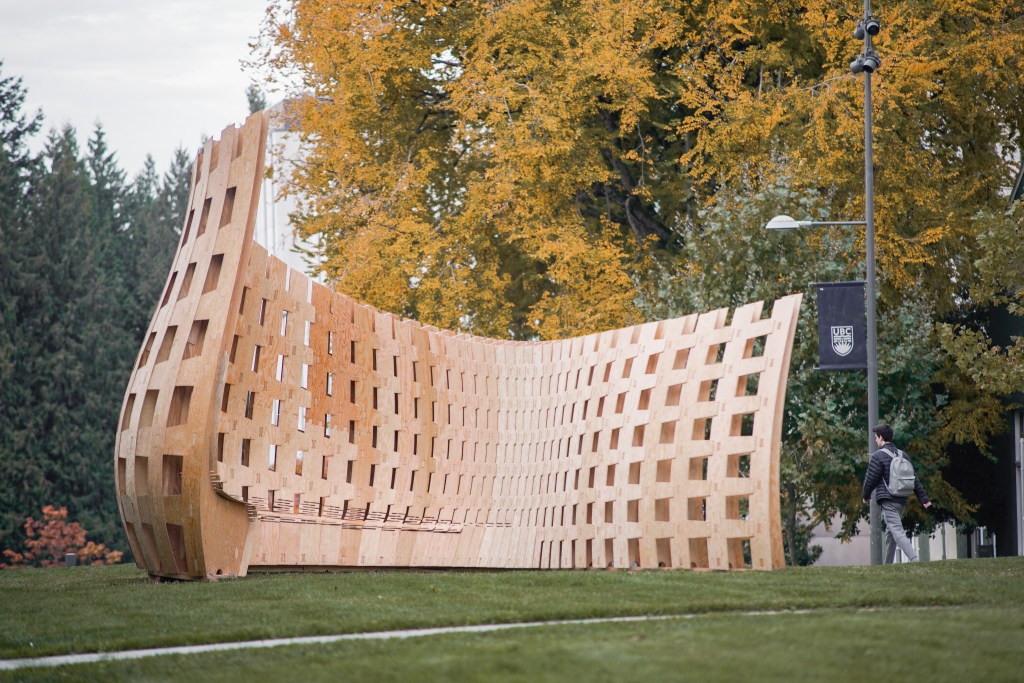
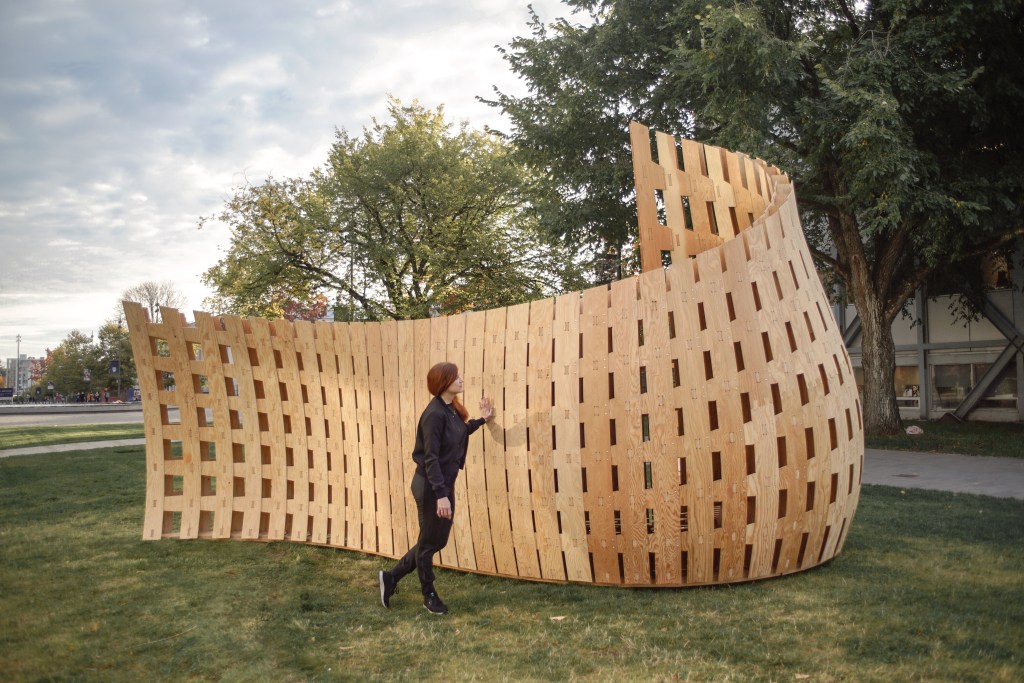
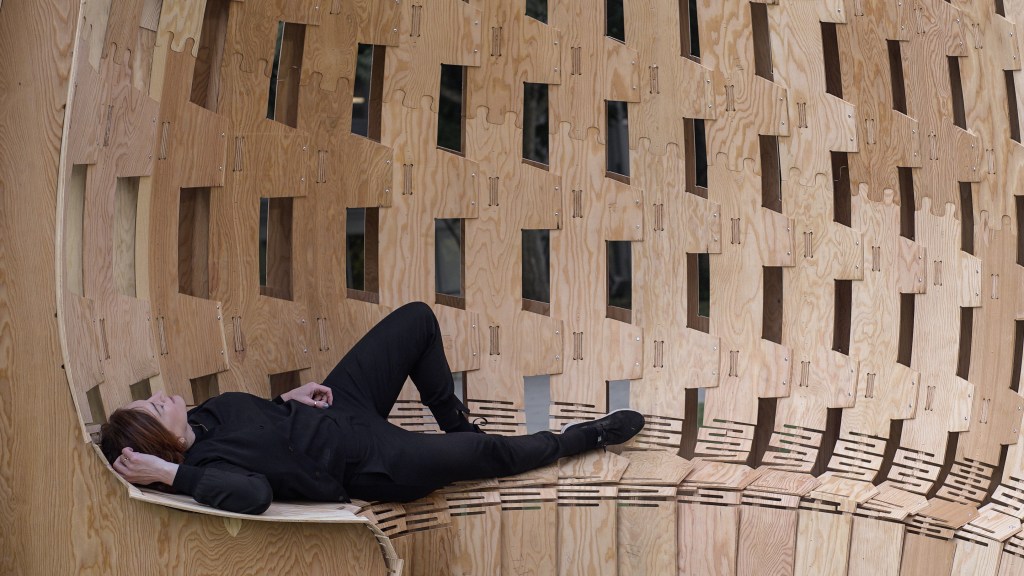
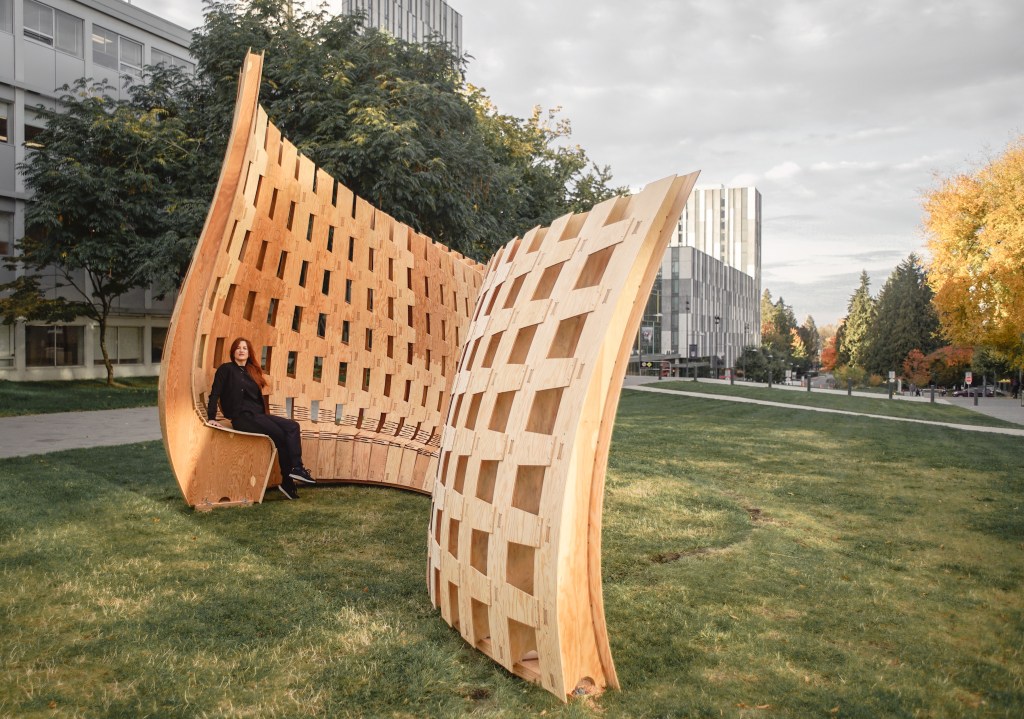
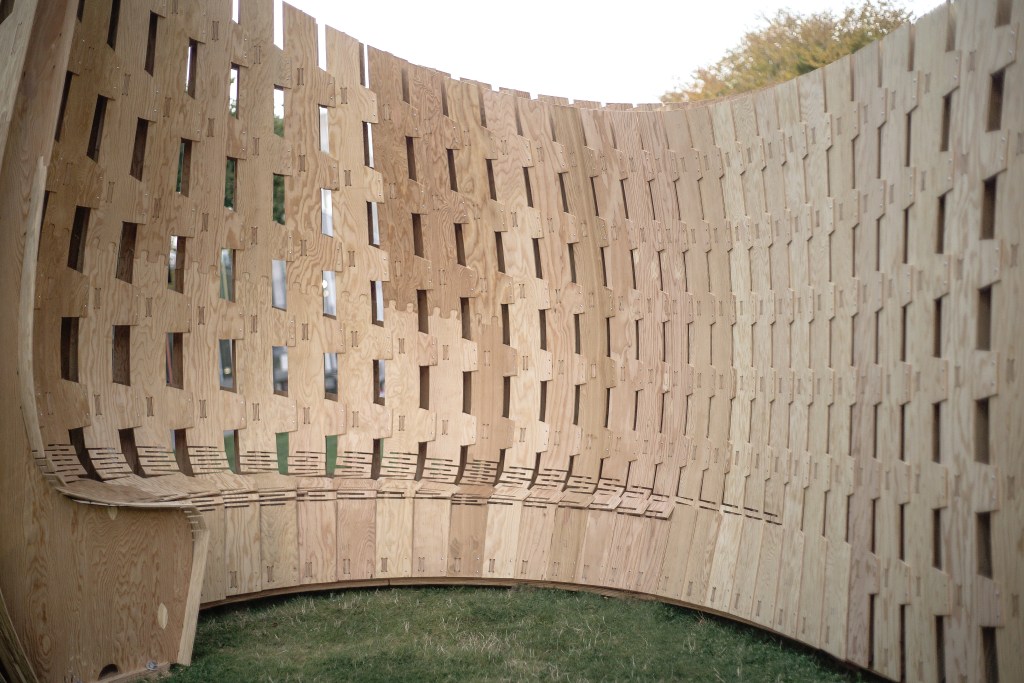
Fabricated and assembled over three days, the pavilion is conceived as an adaptable design-to-fabrication system that can be customized to suit local material availability and fabrication tools. Structurally, the project employs a stressed skin wood system, combining thin, elastically bent plywood skins with a network of plywood ribs acting as webs. This coupling allows loads to be distributed across the full depth of the assembly, resulting in a lightweight yet structurally robust surface structure capable of supporting complex free-form geometry.
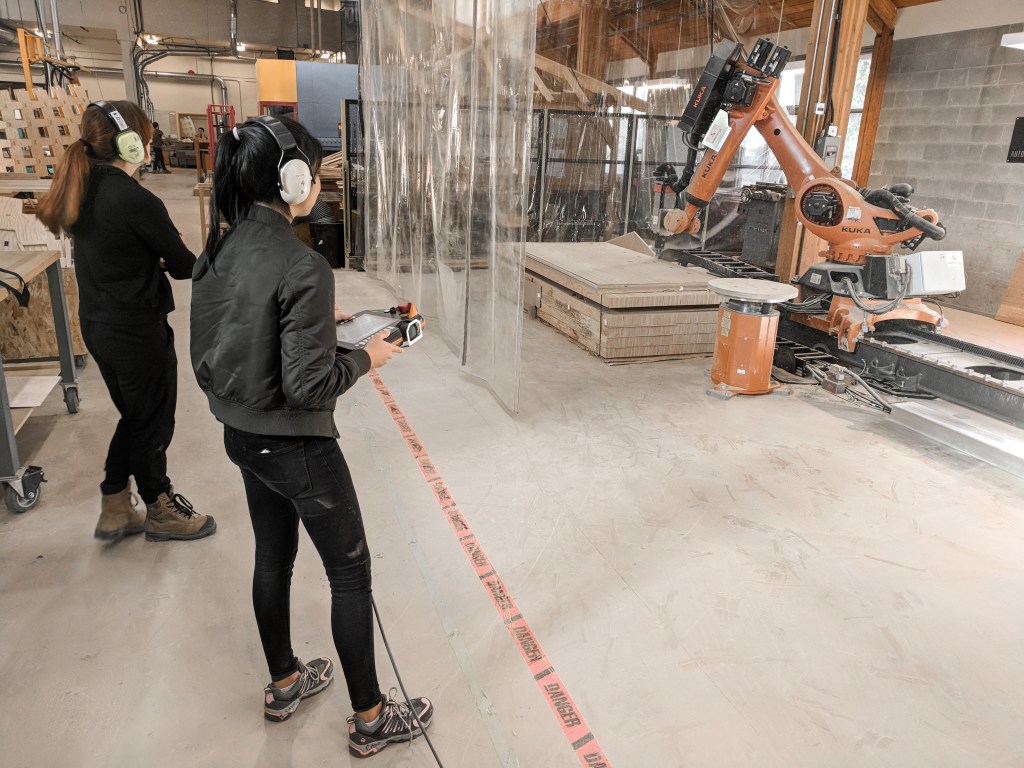
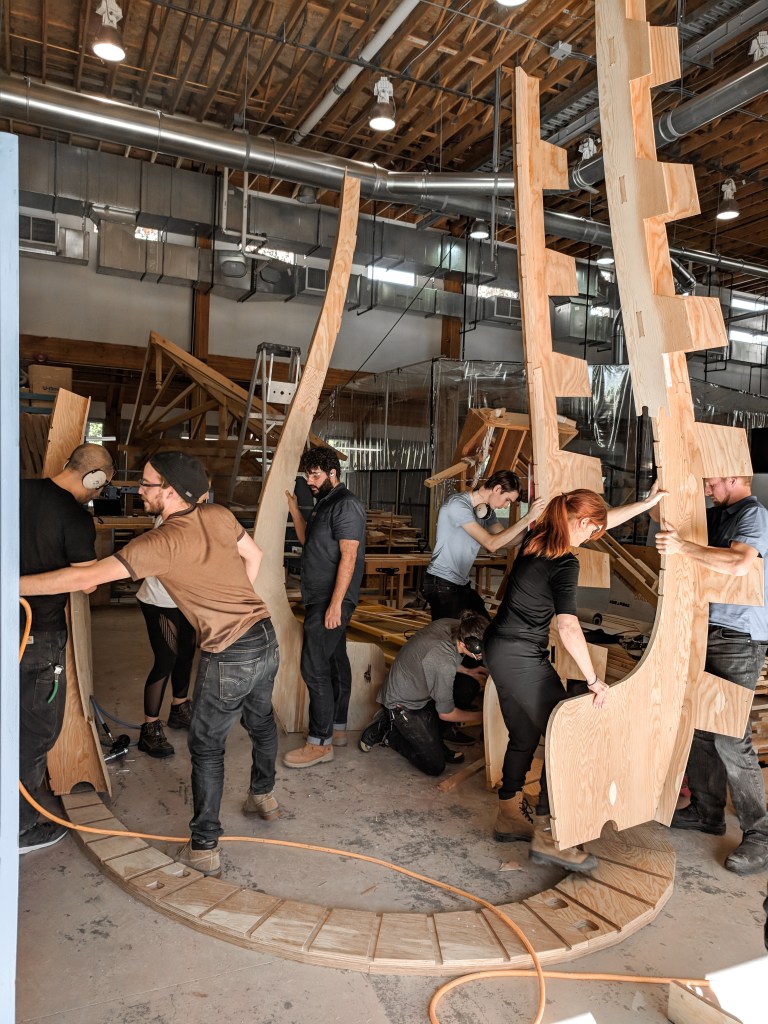
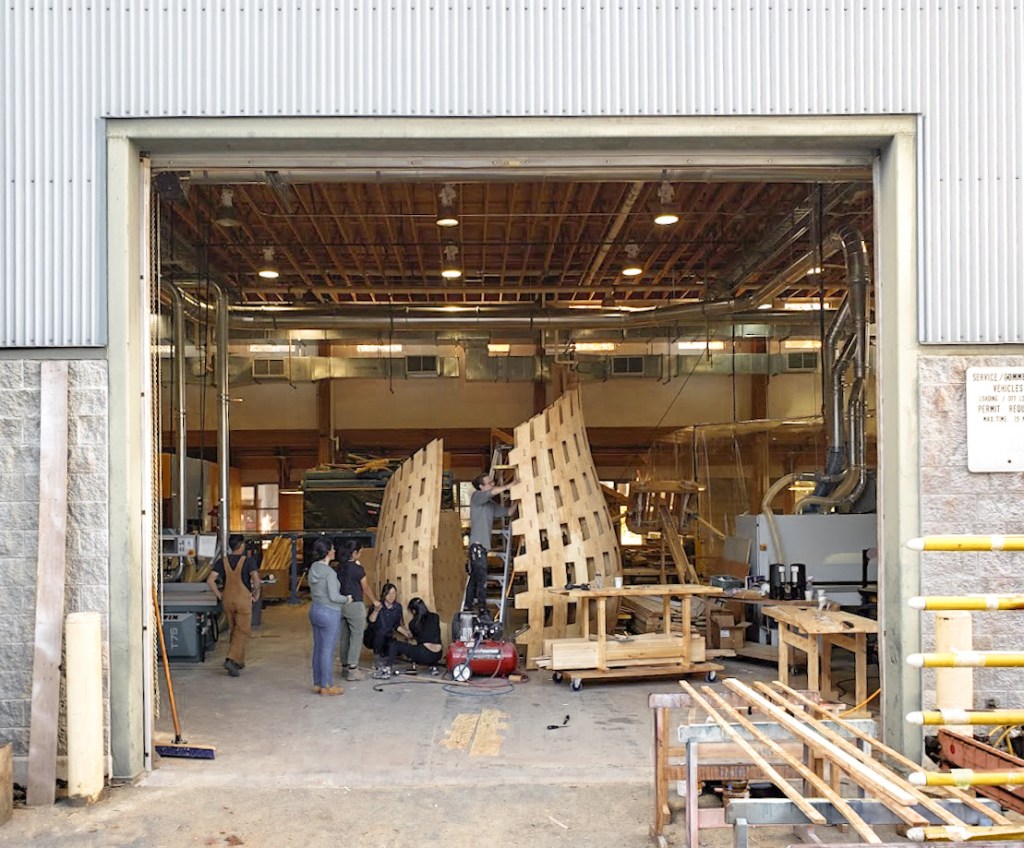
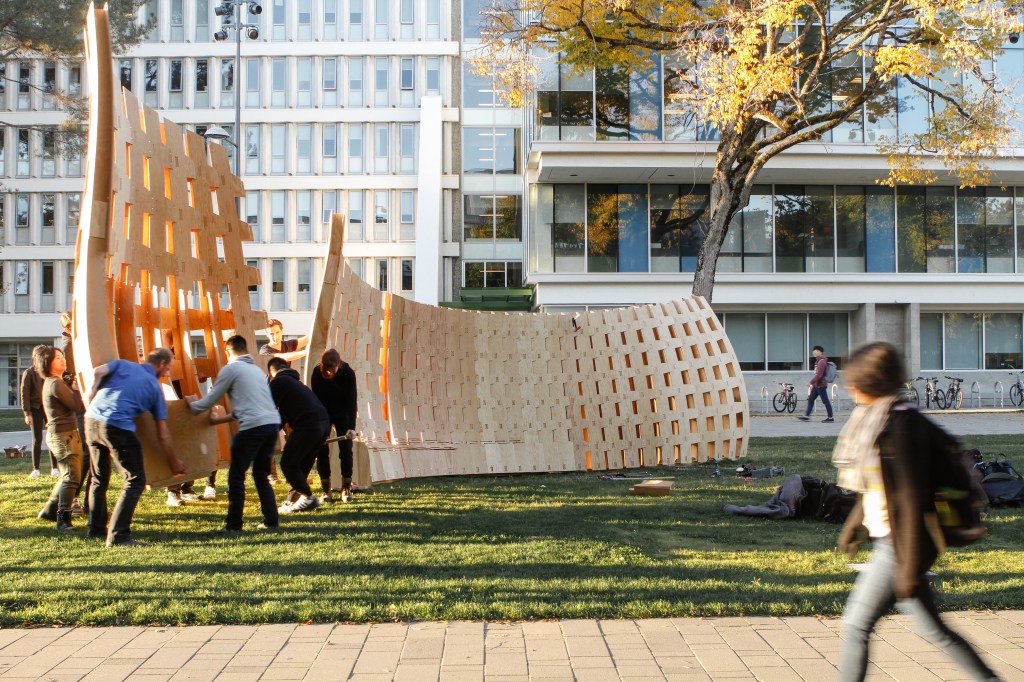
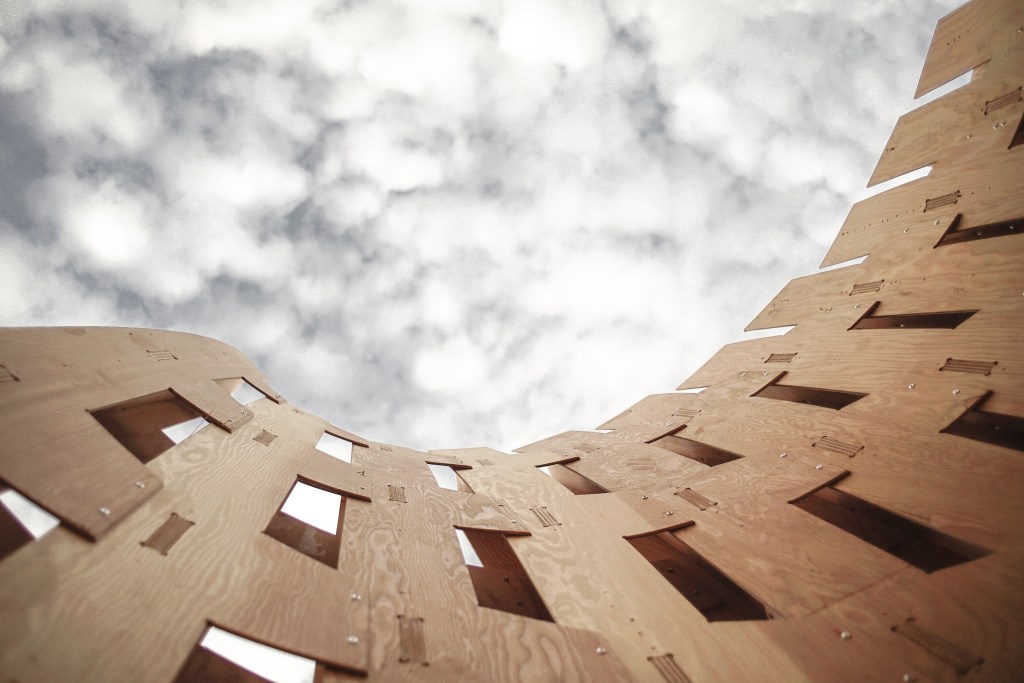
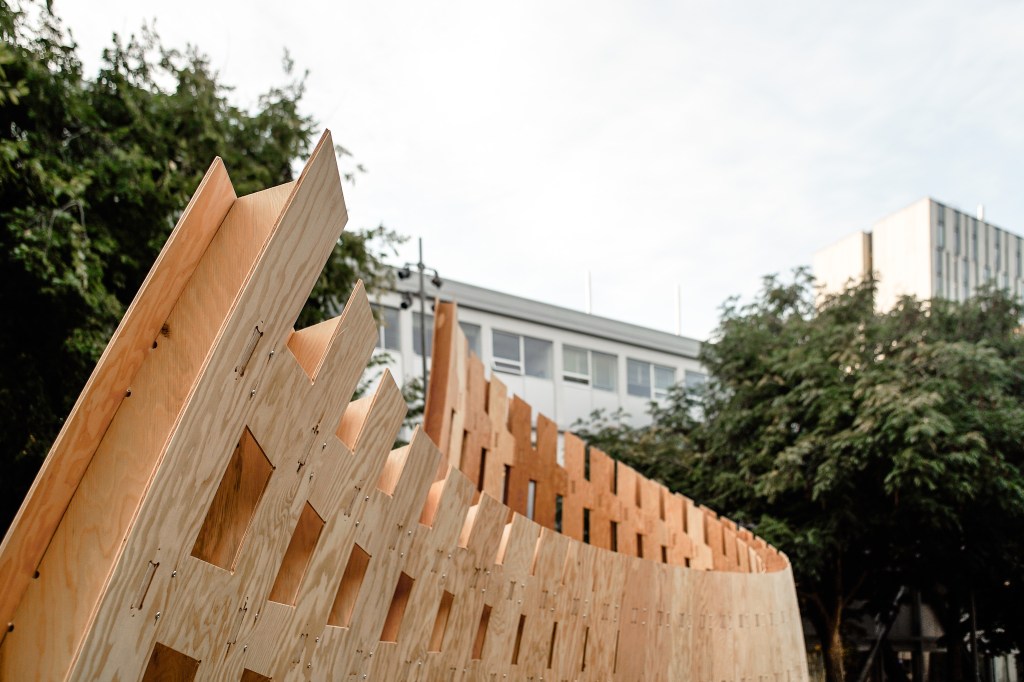
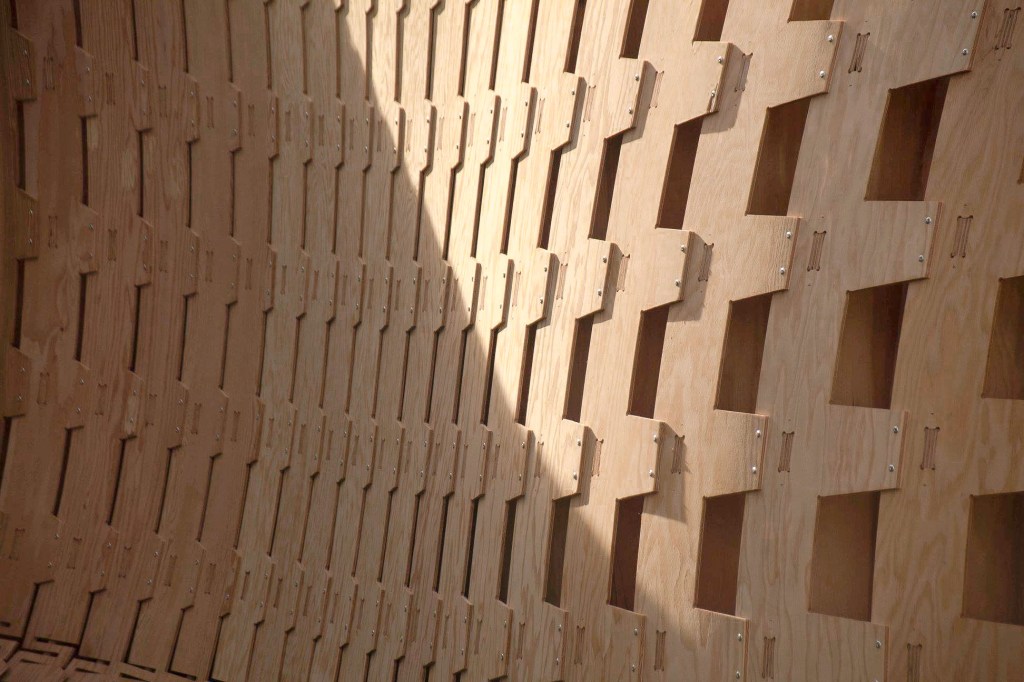
The pavilion is composed of 100 overlapping ¼” plywood skin elements and 50 CNC- and robotically fabricated ¾” plywood ribs. Double curvature is achieved through the elastic bending of the skin panels, transitioning between synclastic and anticlastic geometries along the length of the structure. Robotic fabrication enables high dimensional accuracy, integrated fastening logic, and embedded assembly information through pre-drilled rivet locations. Over 2,200 aluminum rivets—referencing aeronautical stressed-skin construction—connect the skins to the ribs, ensuring precise alignment and geometric fidelity during assembly.
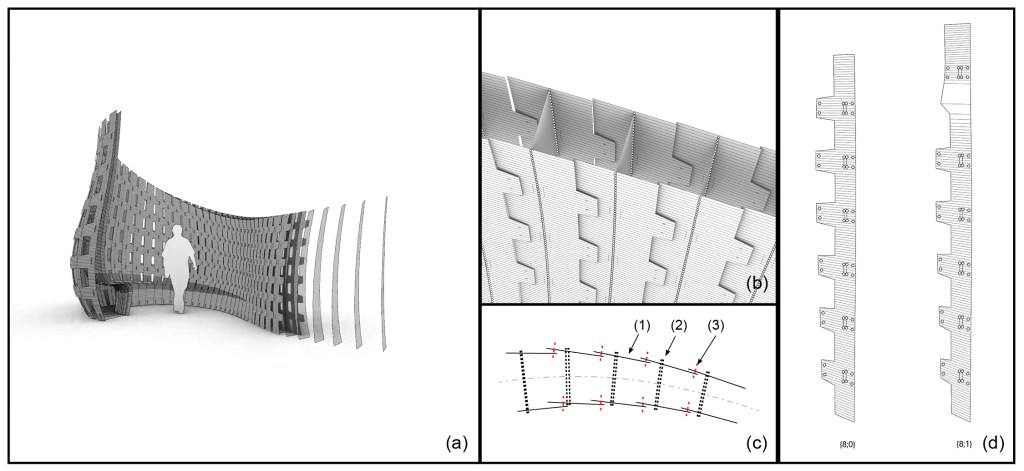
Beyond form and structure, the stressed skin system generates an interstitial cavity that enables material efficiency and opens future potential for integrating services within the surface itself. The Wander Wood Pavilion demonstrates how computational design, robotic fabrication, and material-informed structural systems can be integrated into a single workflow, where form, performance, and assembly emerge simultaneously through fabrication logic rather than post-rationalized construction methods.
Design & Development:
David Correa
University of Waterloo, llLab – Design Laboratory
Oliver David Krieg
LWPAC +IC, odk.design
AnnaLisa Meyboom
UBC SALA
UBC Project Leads
Jason Chiu & Jörn Dettmer
UBC Centre for Advanced Wood Processing
Dean Gregory
Campus and Community Planning
David Gill
UBC SEEDS Sustainability Program
Student participants: Zahra Asghari, John Chan, Selina Chau, Jessica Chen, Alex Floyd, Kemeng Gao, Junting He, Emily Kazanowski, Haobo Liu, Jia Liu, Bryn Martin, Jenna Ratzlaff, Theo Van Vugt, Trevor Vilac, Bahar Ziraknejad
Industry participants: Ivan Antoniw, Tony Bojarsky, Nelson Brito, Aiden Carruthers, Jamie Connolly, Andrew Drakeford, Mahdiar Ghaffarian, Elton Gjata, Michael Hiebert, Marco Kneifel, Mori Kono, Yehia Madkour, Sindhu Mahadevan, Logan Mohr, Nariman Mousavirad, Dai Ona, Aaron Oussoren, Jason Ramelson, Mallory Stuckel, Majd Sukkarieh, Taryn Sheppard
Teaching Assistants: Stuart Lodge & Derek Mavis
Funding:
Forest Industry Innovation
Related Publications:
Meyboom, A., Correa, D. and Krieg, O. D. (2019) ‘Stressed Skin Wood Surface Structure’. Austin (Texas), USA, 2019-10-23 – 2019-10-25, ACADIA, pp. 470–477.
Meyboom, A. and Correa, D. (2022) ‘The path to future wood: Component based structural assembly systems’, in Cruz, P. J. and Hvejsel, M. F. (eds) Structures and Architecture A Viable Urban Perspective?, London, CRC Press, pp. 303–310.
 david-correa.com