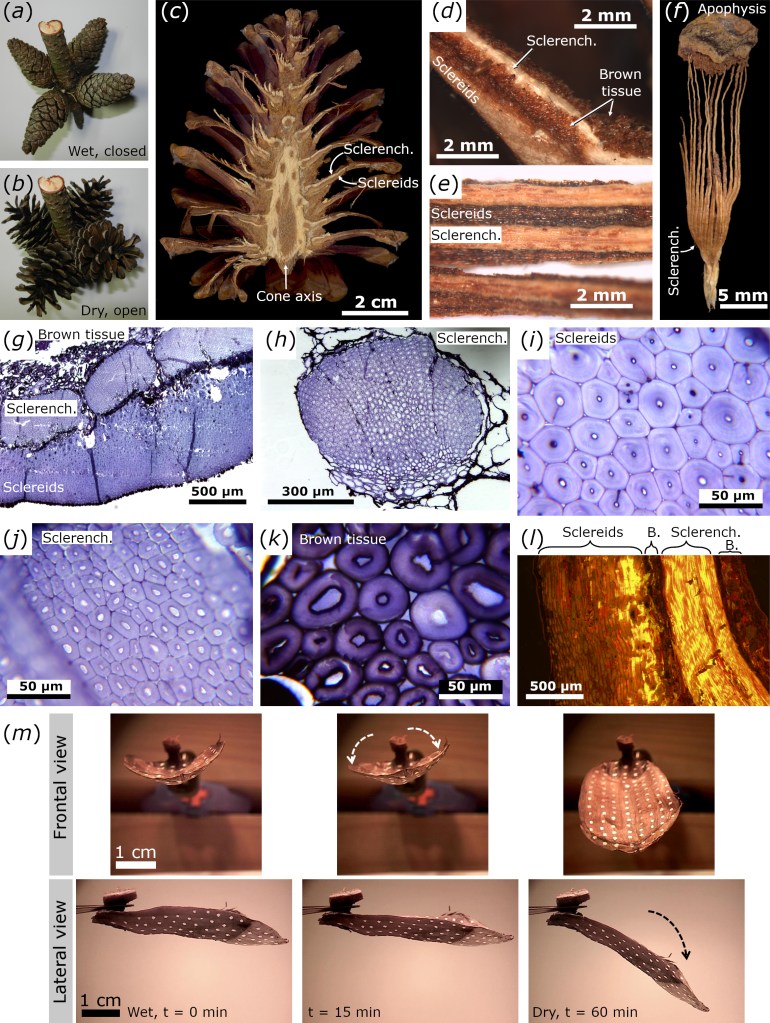
Translating a hygroscopic bilayer principles for stress induced bending from the pine cone scale to a 4D Printed actuator capable of multi-phase motion. The research was based on the Bhutan pine (Pinus wallichiana) cone seed scales as the biological role model.
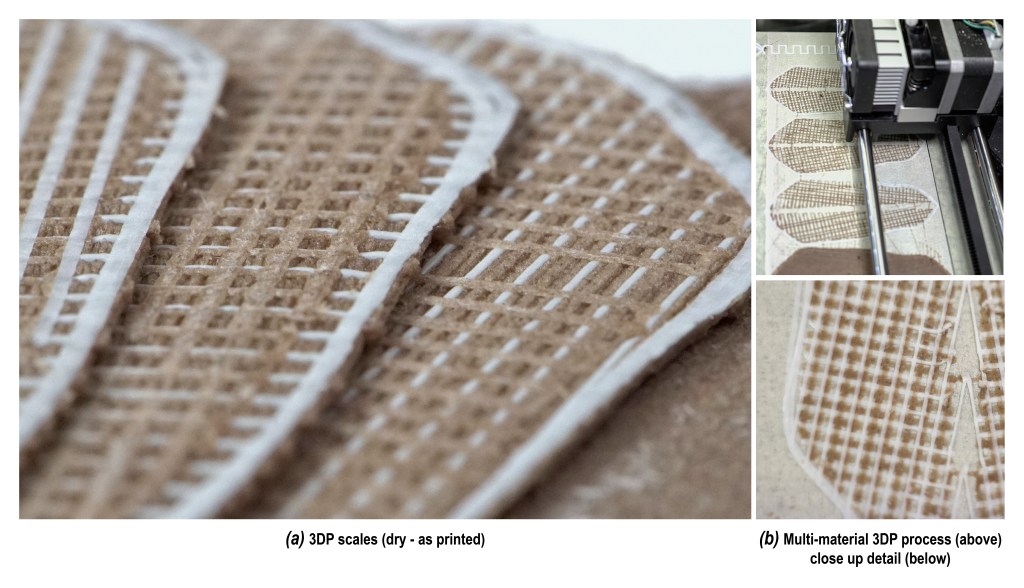
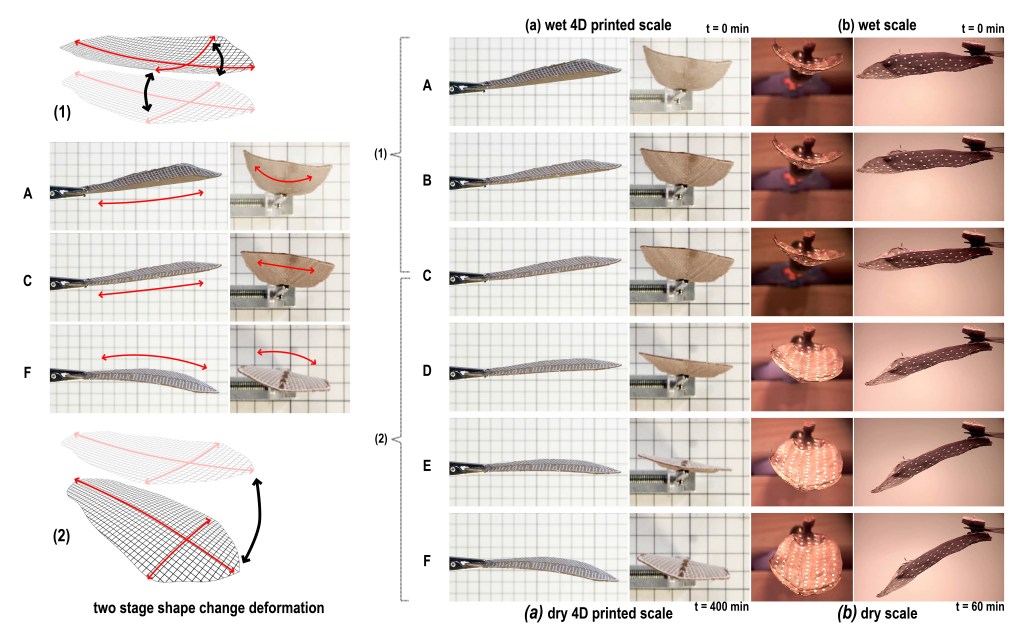
This compliant mechanism that achieves motion in response to climatic changes without failure prone electromechanical components.
Related Publications:
Correa, D., Poppinga, S., Mylo, M. D., Westermeier, A. S., Bruchmann, B., Menges, A. and Speck, T. (2020) ‘4D pine scale: biomimetic 4D printed autonomous scale and flap structures capable of multi-phase movement’, Philosophical transactions. Series A, Mathematical, physical, and engineering sciences, vol. 378, no. 2167, p. 20190445.
Correa Zuluaga, D. and Menges, A. (2015) ‘3D Printed Hygroscopic Programmable Material Systems’, MRS Proceedings, vol. 1800, p. 1016.
Correa, D., Papadopoulou, A., Guberan, C., Jhaveri, N., Reichert, S., Menges, A. and Tibbits, S. (2015) ‘3D-Printed Wood: Programming Hygroscopic Material Transformations’, 3D Printing and Additive Manufacturing, vol. 2, no. 3, pp. 106–116.
Correa, D. (2022) 4D printed hygroscopic programmable material architectures [Online], Stuttgart, Institute for Computational Design and Construction, University of Stuttgart. Available at https://elib.uni-stuttgart.de/handle/11682/12393.
 david-correa.com